Why AI Infrastructure Orchestration Outperforms DIY Models

Jun, 12, 2025
In the current scaling era, the primary bottleneck for AI companies is no longer just model architecture—it is the operational overhead of the underlying infrastructure. While a DIY approach may seem viable for early-stage experimentation, it creates a "Scaling Wall" that stalls production velocity.
The Hidden Costs of DIY AI Infrastructure
The DIY model relies on assembling fragmented components like GPU schedulers, monitoring tools, and custom automation scripts. This manual orchestration introduces five critical operational risks:
High DevOps Burden
Engineering resources are drained by infrastructure maintenance.
Inconsistent GPU Utilization
Fragmented tools lead to resource silos and wasted capital.
Limited Observability
A lack of deep visibility into system failures and real-time performance.
Administrative Friction
Manual management of users, quotas, and complex billing.
Scaling Inhibitors
Increasing difficulty in extending infrastructure across multiple teams or external customers.
Nucleaton™ vs. DIY Infrastructure
The following table highlights the transition from fragmented, manual setups to unified, turnkey orchestration.
Operational Model
Nucleaton™
Turnkey Orchestration
DIY Infrastructure
Manual Assembly & Scripting
Engineering ROI
Nucleaton™
Zero-Expertise Operations
DIY Infrastructure
High DevOps Maintenance
Compute Efficiency
Nucleaton™
Automated Optimization
DIY Infrastructure
Sub-optimal GPU Utilization
Infrastructure Visibility
Nucleaton™
Unified Control Plane
DIY Infrastructure
Fragmented Observability
Scaling Velocity
Nucleaton™
Instant & Infrastructure-Led
DIY Infrastructure
Headcount Dependent
Scaling Velocity
Nucleaton™
Automated Usage Attribution
DIY Infrastructure
Manual Quota Management
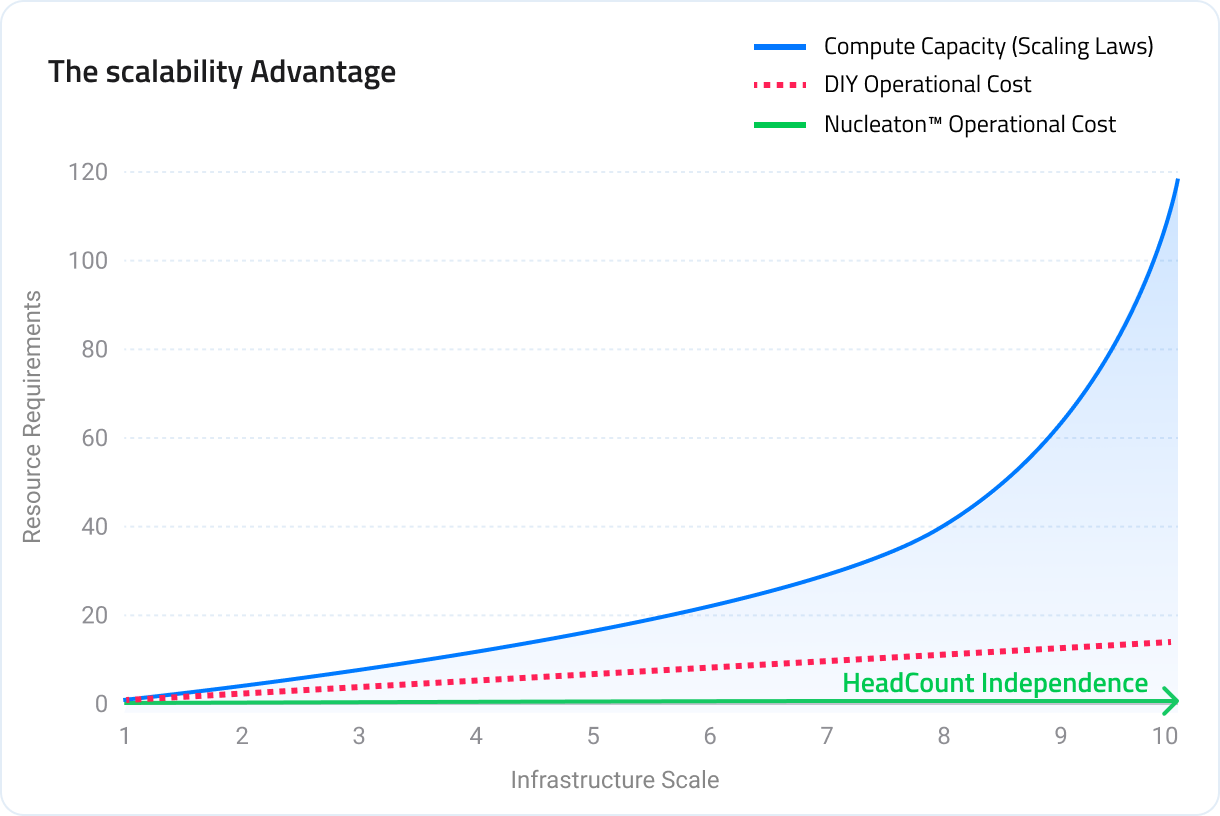
Breaking the Linear Dependency
The most compelling reason to transition to a turnkey platform is to achieve Headcount Independence.
In a traditional DIY setup, infrastructure complexity grows linearly with your GPU footprint, forcing a constant cycle of hiring. Nucleaton™ breaks this dependency. By decoupling orchestration from manual DevOps, you enable your compute capacity to follow Scaling Laws while your operational costs remain flat.
When to Transition to Turnkey Orchestration
Choosing a turnkey platform like Nucleaton™ is a strategic necessity for organizations moving beyond the lab. It is the superior choice for:
- 1.
Multi-tenant Environments
Managing shared GPU clusters across diverse teams without resource contention.
- 2.
Production Reliability
Deploying workloads with strict uptime and cost requirements.
- 3.
Infrastructure Monetization
For organizations looking to sell AI services or compute access.
- 4.
Rapid Scaling
Teams where AI usage is growing faster than DevOps headcount can support.
Stop building infrastructure and start scaling workloads. See how Nucleaton™ can unify your orchestration and automate your GPU efficiency in a live, technical walkthrough.